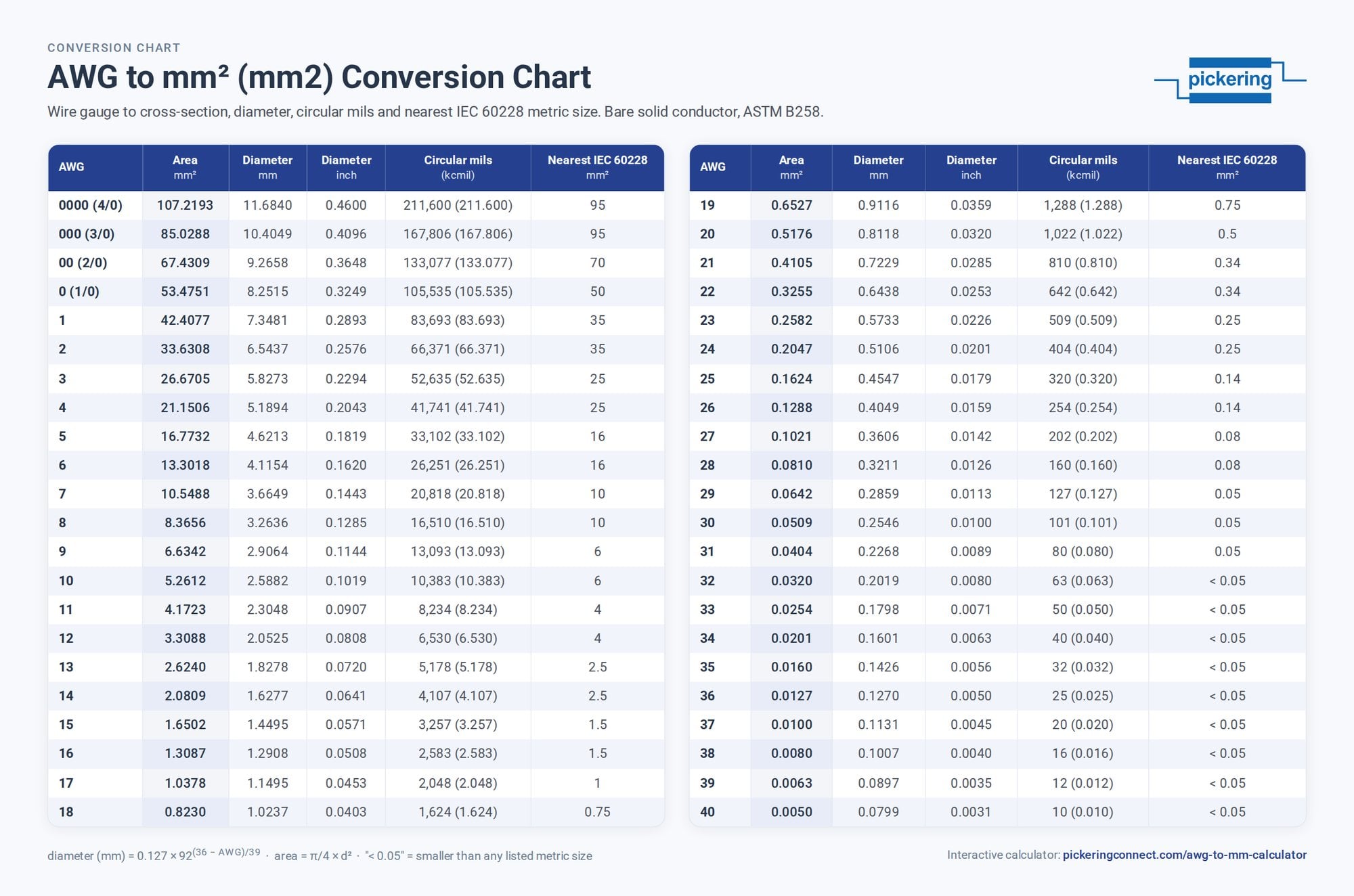
The full AWG to mm² chart from 0000 (4/0) down to 40 AWG. Every value is calculated from the ASTM B258 formula the calculator above uses, for a bare solid round conductor. The last column shows the closest standard metric cross-section, so you can match an AWG wire to its nearest IEC 60228 equivalent.
| AWG | Area (mm²) | Diameter (mm) | Diameter (inch) | Circular mils (kcmil) | Nearest IEC 60228 size (mm²) |
|---|---|---|---|---|---|
| 0000 (4/0) | 107.2193 | 11.6840 | 0.4600 | 211,600 (211.600) | 95 |
| 000 (3/0) | 85.0288 | 10.4049 | 0.4096 | 167,806 (167.806) | 95 |
| 00 (2/0) | 67.4309 | 9.2658 | 0.3648 | 133,077 (133.077) | 70 |
| 0 (1/0) | 53.4751 | 8.2515 | 0.3249 | 105,535 (105.535) | 50 |
| 1 | 42.4077 | 7.3481 | 0.2893 | 83,693 (83.693) | 35 |
| 2 | 33.6308 | 6.5437 | 0.2576 | 66,371 (66.371) | 35 |
| 3 | 26.6705 | 5.8273 | 0.2294 | 52,635 (52.635) | 25 |
| 4 | 21.1506 | 5.1894 | 0.2043 | 41,741 (41.741) | 25 |
| 5 | 16.7732 | 4.6213 | 0.1819 | 33,102 (33.102) | 16 |
| 6 | 13.3018 | 4.1154 | 0.1620 | 26,251 (26.251) | 16 |
| 7 | 10.5488 | 3.6649 | 0.1443 | 20,818 (20.818) | 10 |
| 8 | 8.3656 | 3.2636 | 0.1285 | 16,510 (16.510) | 10 |
| 9 | 6.6342 | 2.9064 | 0.1144 | 13,093 (13.093) | 6 |
| 10 | 5.2612 | 2.5882 | 0.1019 | 10,383 (10.383) | 6 |
| 11 | 4.1723 | 2.3048 | 0.0907 | 8,234 (8.234) | 4 |
| 12 | 3.3088 | 2.0525 | 0.0808 | 6,530 (6.530) | 4 |
| 13 | 2.6240 | 1.8278 | 0.0720 | 5,178 (5.178) | 2.5 |
| 14 | 2.0809 | 1.6277 | 0.0641 | 4,107 (4.107) | 2.5 |
| 15 | 1.6502 | 1.4495 | 0.0571 | 3,257 (3.257) | 1.5 |
| 16 | 1.3087 | 1.2908 | 0.0508 | 2,583 (2.583) | 1.5 |
| 17 | 1.0378 | 1.1495 | 0.0453 | 2,048 (2.048) | 1 |
| 18 | 0.8230 | 1.0237 | 0.0403 | 1,624 (1.624) | 0.75 |
| 19 | 0.6527 | 0.9116 | 0.0359 | 1,288 (1.288) | 0.75 |
| 20 | 0.5176 | 0.8118 | 0.0320 | 1,022 (1.022) | 0.5 |
| 21 | 0.4105 | 0.7229 | 0.0285 | 810 (0.810) | 0.34 |
| 22 | 0.3255 | 0.6438 | 0.0253 | 642 (0.642) | 0.34 |
| 23 | 0.2582 | 0.5733 | 0.0226 | 509 (0.509) | 0.25 |
| 24 | 0.2047 | 0.5106 | 0.0201 | 404 (0.404) | 0.25 |
| 25 | 0.1624 | 0.4547 | 0.0179 | 320 (0.320) | 0.14 |
| 26 | 0.1288 | 0.4049 | 0.0159 | 254 (0.254) | 0.14 |
| 27 | 0.1021 | 0.3606 | 0.0142 | 202 (0.202) | 0.08 |
| 28 | 0.0810 | 0.3211 | 0.0126 | 160 (0.160) | 0.08 |
| 29 | 0.0642 | 0.2859 | 0.0113 | 127 (0.127) | 0.05 |
| 30 | 0.0509 | 0.2546 | 0.0100 | 101 (0.101) | 0.05 |
| 31 | 0.0404 | 0.2268 | 0.0089 | 80 (0.080) | 0.05 |
| 32 | 0.0320 | 0.2019 | 0.0080 | 63 (0.063) | < 0.05 |
| 33 | 0.0254 | 0.1798 | 0.0071 | 50 (0.050) | < 0.05 |
| 34 | 0.0201 | 0.1601 | 0.0063 | 40 (0.040) | < 0.05 |
| 35 | 0.0160 | 0.1426 | 0.0056 | 32 (0.032) | < 0.05 |
| 36 | 0.0127 | 0.1270 | 0.0050 | 25 (0.025) | < 0.05 |
| 37 | 0.0100 | 0.1131 | 0.0045 | 20 (0.020) | < 0.05 |
| 38 | 0.0080 | 0.1007 | 0.0040 | 16 (0.016) | < 0.05 |
| 39 | 0.0063 | 0.0897 | 0.0035 | 12 (0.012) | < 0.05 |
| 40 | 0.0050 | 0.0799 | 0.0031 | 10 (0.010) | < 0.05 |
Sizes below 0.5 mm² (0.05 to 0.34 mm²) are common metric wire sizes below the IEC 60228 range. “< 0.05” means the wire is smaller than any listed metric size. Stranded conductors of the same AWG have a slightly larger overall diameter.